Thursday, December 6, 2012

Pilgrimage to Vandemere

Launching Skorpa, sailing her for the first time out the breachway and into the ocean, were important milestones but taking Skorpa to Vandemere the home of her designer was particularly memorable. Our trip was a bittersweet mixture of fulfillment and disappointment.  Graham Byrnes the designer of the EC 22 hosts an annual gathering at his shop on the water there. Sally and I went a few days early and got some wonderful sailing in and stayed our first three nights on the boat.


 On Thursday Graham decide to postpone the gathering until the following week as Hurricane Sandy was prowling up the coast. I had been looking forward to seeing some friends that we had met at previous gatherings and sharing my boat with others, but there was no way that Sally and I could stay an additional week. On Friday evening Graham and Alan, an experienced sailor who works for Graham came out with me for a sail. It was cloudy but we had some nice wind. Usually I am the most experienced sailor on board and when the wind picks up I feel a little tense, nervous, concerned for the safety of the boat and anyone with me. With Alan and Graham aboard that was all lifted from me and we just soared along.


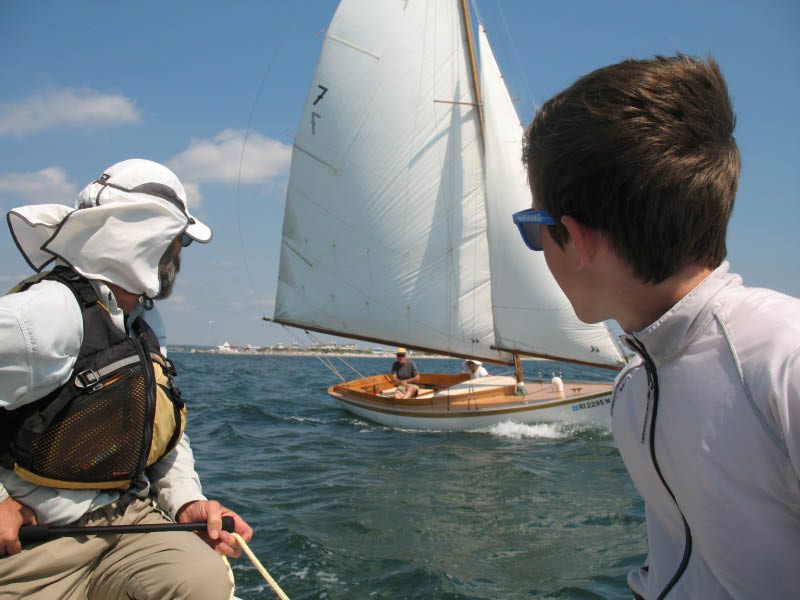
Since I started work on this boat Graham has become a friend and mentor so it was very special to go for a sail with him and see how pleased he is with the boat. You can see the clouds associated with the approach of Hurricane Sandy. The winds were beginning to pick up but they were still a very manageable 10-15 knots

Graham had tweaked the EC 22 design somewhat after his extensive experience with Southern Skimmer. Skorpa is the first boat built to this updated design. The design changes included some minor increases in the scantlings. Graham built Southern Simmer to be as light as possible. He has not experienced any structural failures even though he pushes his boat very hard, still he felt a few places should be beefed up a bit before the design was turned loose to the general public. Skimmer did exhibit some lee helm. It was necessary to use the rudder to prevent the boat from turning down wind. Graham addressed this issue by moving the mizzen mast aft a little and the centerboard forward slightly. This brought the boat into balance so little or no rudder effort is necessary to keep the boat going on course. You can see in the above photo that Alan is not applying much force on the tiller and the rudder is nearly centered.

Graham is not as expressive as Alan but they both had high praise for  Skorpa. Both of these guys have a huge amount of experience pushing boats to their limits.

Graham liked the way I had extended the cabin 6 inches further forward and the way I finished the cabin interior adding a small navigation table/galley.


Graham suggested that I apply some non skid paint to the cockpit. That was already on my to do list as the seats get slippery. He also had some ideas for making reefing easier. Alan had some ideas on how to better route the halyards. I would have loved to stay longer and to sail some more with Alan and Graham but Sandy was knocking at the door and Sally and I thought it was best for us to head inland.

Saturday afternoon Sally and I packed up and headed home to Ferrum.


Thursday, November 8, 2012

A few projects finished up

I struggled for quite awhile working on sail covers. I was not able to try them on until we were all the way down in Vandemere for the 2012 Mess About.


Another project I have been working on are my oars. I did a turkish knot to act as a keeper for the oarlocks. I was not able to give them a test until our Virginia boat launch at Philpott Lake.


The boat is pretty large to be rowing but I was able to move along fairly well. Of course as you can see there was not any wind or waves to deal with. Keeping track of where I am going is a bit awkward as I have to stand up a little and look over my shoulder. I found it relatively comfortable to row either sitting or standing. I did not have time to try rowing any great distance but I am sure my time will come. Of course long ago I had made the decision not to have an outboard for auxiliary power.

The basic turkish knot has three lines that weave in and around each other. You then follow those lines with multiple passes until the knot fills out. I decided to try a turkish knot that has five leads. It was a lot more difficult to get started. It results in a knot that is a little wider.


Monday, October 15, 2012

A couple of projects

Sunlight degrades the dacron that the sails are made from. My boat does not spend as much time at anchor with the sails furled as some boats, but still I would fill better if the sails had covers. I got some books from the library and ordered some marine fabric Sunbrella.


I sharpened the tip of an old soldiering iron and used it to cut and heat seal the fabric. I am doing this on an old piece of window glass.

My old Singer is at its limits trying to sew multiple layers of heavy fabric. I am working on sail covers as well as covers for the cushions in the cabin. The covers are finished but you will have to weight for some good photos of the finished products.


Second project is a power box for Skorpa's electrical system.


Monday, October 1, 2012

Overnighter and out on the Open Seas

Sally's brother David and his wife on board Little Dipper II joined Sally and I and a friend from Austria for a little sailing adventure.

Little Dipper II is a fiberglass reproduction of a Herreshoff designed Petrel. This is a 21 foot overall day sailor that David has equiped with a cockpit canopy that makes overnights possible.


We sailed out of Point Judith harbor towards Block Island for a few miles. The weather was warm and sunny and the wind around 10 knots. The two boats are similar in overall length but very different in design.Skorpa is a light centerboarder with a relatively flat planing hull. Dipper is a full keeled displacement boat with several hundred pounds of outside lead ballast. We had great fun sailing together.


This is Skorpa at home on the open water.

Moritz and I are hailing Little Dipper. We need to decide on a rendezvous point and a place to swim.

Tweaking the sails for a little more speed. Having trouble losing these guys.

After the sail and a swim it was time for a little R&R.

The water is clean and cool making warming up in the sun a real pleasure.


This is in the evening after we have settled down for the night at our anchorage.


Wednesday, August 15, 2012

Launch Party

Sunday I rigged up an ancient block and tackle and used it to haul Skorpa up the neighbors beach. A couple of rollers made the job go fairly easily. We had invited neighbors and a few friends and relatives to come for our official launch.

I told everyone how SKORPA got her name and thanked neighbors and family for helping. One of the neighbors chimed in " and for putting up with the noise" I had forgotten but there were numerous times over the years when the router or planer was whining in the driveway at odd hours of the day or night.

That is Sally standing on the far right followed by her friend Grace, Aunt Arline, Heidi, and John Ciolfi is holding the boat from banging around.


We served fresh fruit and of course lots of Skorpa. I splashed a little cognac on the deck and we rolled her into the water to a hearty cheer.


Now what I was hoping was that one or two trusty sailors would go for a short sail with me in front of the house while the others would watch, chat for awhile and then wonder off  before anything unfortunate occurred. But that is not exactly what happened.

David (trusty sailor) and Grace came with me first. We drifted slowly away from the beach and then began to pick up speed as we got into the wind. As we rounded Thomas Point we felt the full force of the wind. 10 knots form the south with gusts to around 15 knots. That is not a huge amount of wind but enough to heal the boat.

Skorpa is in the foreground and a larger sloop is ahead of us. We are just rounding the Point and beginning to feel the wind.

Here I learned something that I did not know about cat ketches. I understood that a key to survival was to keep the mainsheet in hand so if the boat begins to be overpowered by a wind gust the sheet can be quickly released. I made sure that no one sat on or in front of the mainsheet.

We were sailing along close hauled when a gust of wind began to heal us over. The boat developed a little weather helm which is OK. The wind grew stronger and the boat began to heal further. Grace and David were reaching for something to grab hold of. I released the main sheet. The boat leveled out a little but developed a huge amount of weather helm. The boat was trying to head up into the wind I was using a lot of force to hold the tiller over. The rudder was being dragged sideways through the water. We were slowing down. Things did not feel right. I was fighting to control the boat. We came about and headed back towards the lee of the land where there was less wind.

We glided up to the beach and there was another group that wanted to go for a sail. This was not what I wanted. I was a little concerned that something would go wrong and someone could get hurt. I made sure that the centerboard was all the way down. I noticed on the way in that it was only partly down. This seemed to help. I also learned that when the boat is hit by a gust and the mainsheet is eased it is important to ease the mizzen a little. The two sails are on the ends of the boat. The main way up front and the mizzen in the stern. This allows you to balance the forces on the boat by trimming one sail in or out a little. You can make the forces on the rudder neutral or even steer the boat just by slight adjustments on the sails. Of course if in a gust of wind you suddenly dump one sail while the other is sheeted in tight you can develop strong steering forces and overpower the rudder. Releasing the main causes weather helm and steers the boat up into the wind, rather like turning across a ski slope. Releasing the mizzen imparts lee helm which turns the boat down wind like heading straight down the slope.

I was beginning to relax a little. I also began to see Skorpa's boat launch as being less about me and a little more about the people waiting on the beach for a ride. An older man who lives on the road hobbled down to the waters edge and said he would really like to go for a ride. He required a lot of help just getting into the boat. We sailed back and forth. He was beaming and pointed with excitement as we sailed past his house.

Next David, Judy, and Sally got into the boat. With the centerboard all the way down and the mizzen sheeted out a little more we headed into the wind. Slorpa soared feeling solid, balanced and alive.


Monday, August 13, 2012

Thank You

Sorkpa is in the water. There has been a lot of work on my part, but this could never have been accomplished without the help and support of many people.

My wife Sally who was always available to mix epoxy, move lumber, clamp squirming laminates and dozens of other tasks where I needed or wanted an extra hand.

Friends and neighbors who helped turn the boat, loan tools or just give encouragement.

Graham Byrnes who believed I could do this from the beginning, created such a beautiful and functional design, and whose enthusiasm for the joy of boating is so contagious and generously shared.

Skorpa's launch was a two stage affair. First stage was trailering Skorpa to the boat ramp and prelaunching her.


Second stage was pulling the boat up on the beach and inviting friends, family and neighbors over for an official launch.

Here Skorpa is off leaving the safety of the driveway for our first adventure.

At the ramp the boat needs to be rigged. First the masts need to be raised.

This involves reaching low to fasten the bolt at the base of the tabernacle.

And reaching high to attach the main snotter.


Then off into the water we go. Hurrah! The weight of the boat on the trailer is carried primarily on the keel rollers. This allows the boat to be launched and retieved without submerging the trailer as is usually done.
You can see the trailer tires are just at the waters edge.

Now lets see this line goes here and that line goes there or is it.

The wind were 10 knots with gusts to 15 knots from the southeast. I did not feel comfortable raising the mainsail before launch because there was a dock and a low bridge down wind of us and I didn't have a good way to hold the boat as I raised the main. In the photo the boat is being held by an anchor. I did not want to deal with raising the anchor and stowing it while trying to get under way. Sally suggested that we leave under mizzen alone. This turned out to be a good solution and we got underway without incident.

My neighbor and friend up here at Great Island John Ciolfi offered to help with the launch and sail with me about a mile back to the house. Since we could not fit under the bridge we went the back way through the shallows of East Pond. We had an exciting sail back to our anchorage. The skys and the forecast were threatening thunderstorms. Everything on the boat was untested. But here we were. I was happy that we were on familiar water and home was not far away.

When the winds gusted I could feel the boat surge forward and heal over. In a very short time we were sailing in front of the house. We sailed about for awhile and then decided to tie up at my preset anchor. The sky was heavy with low clouds and the wind was gusty.

A couple hours after we landed a line of severe thunderstorms came through with torrential rains and 40 mph wind gusts.


Friday, August 10, 2012

Prepare for Launch

I decided to name my boat SKORPA this is in honor of my grandfather who loved to dunk skorpa in his coffee and my grandmother who lovingly baked and dried the cardamon flavored coffee bread. My grandparents were born in Sweden and Algut Julius loved boats as much as he loved skorpa..

I have been baking skorpa for years and made up a batch to hand out at the launching.


 Lots of small tasks to be done. Rub strips needed to be added to the masts to prevent the sprits from rubbing on the sail track. 24 6-32 holes to be drilled and threads cut into the aluminum.


I raised the masts in the driveway convenient but perhaps not the wisest place because of the proximity of power lines.


Everything went pretty smoothly except a few weeks ago I had decided that the mizzen mast had just a wee bit too much play as it passsed through the mast partner. I added a couple of coats of epoxy to the sleeve.

When I went to plant the mizzen mast it jammed about a 1/2 inch into the seat. I couldn't pull it out and I couldn't push it down. I thought about asking Sally to get one of the neighbors to help but two of us jerking on the 22 foot mast might have made it worse.

Finally I gave the mast a mighty heave and it popped out as I wobbled about like someone doing a poor move on the balance beam. Sorry no photos.